en
  • Deutsch
  • English
  • Français
  • Nederlands
  • Italiano
  • Slovenský
  • Polski
  • ελληνικά
  • Čeština
  • Norsk
  • Ukrainian
  • Chinese
Enter search...
Construction
Products
Product categoriesOTTOSEAL® sealantsOTTOCOLL® adhesivesOTTOFLEX® system compound sealingOTTOPUR PU foamsSmoothing agentsAdditional productsPrimers / CleanersGunsProcessing tools / AccessoriesNozzles / Static mixing nozzlesTapes / Back-up foam rods
Find productProduct filterApplication assistantAdhesive compass
ConsultationUsage calculatorColour recommendationsPrimer tableOTTO AppApplication consultationFAQ
DownloadsData Sheets / CertificatesGuns – Spare parts and instructionsGuides, catalogues, brochures
Application areas
Tiles - ceramic - bathroomNatural stone - marbleGlass - window - façadeFinishings - assembly
Service
ConsultationUsage calculatorColour recommendationsPrimer tableOTTO appApplication Consultation
Order & deliverCustomer order formDelivery options at OTTOOrder optionsDistributors
ProductionDemand-oriented productionColour variety
KnowledgeApplication VideosOTTO anti mouldRequired training for processing diisocyanates
NewsSubscribe to OTTO newsletterLatest distributor news
Media
CataloguesOnline catalogue
Product informationData sheets & test certificates
ConsultationOTTO Professional GuidesIVD-Instruction SheetsOTTO brochuresOTTO product overviews
Images & VideosMedia portal
IndustryABOUT OTTO
  1. Construction
  2. Application areas
  3. Glass - window - façade
  4. The bonded window
  5. Reliable in the result

Confident in the result

Reliable in the choice of products, in processing, but just as reliable in the result! With our products and processing options, you always achieve a reliable result that not onlyensures thelongevity of the window , but also stands for perfect quality . Furthermore, we accompany you together step by step to the RC examination.
The quality control

There are different types of quality control, depending on the objective of the test.

  • Determination of the pot life
  • Glass plate test
  • Butterfly test
  • Adhesion test (peel test)*

Determination of the pot life

Aim of the test:
The correct mixing ratio or the correct curing speed is checked by determining the pot life.

Implementation:
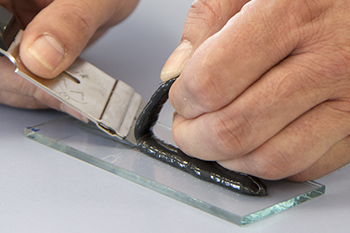
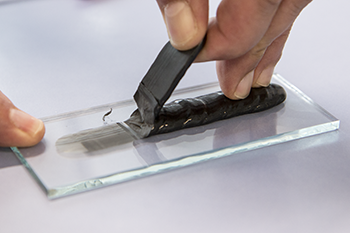
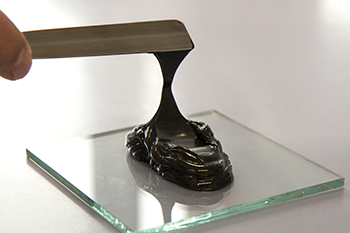
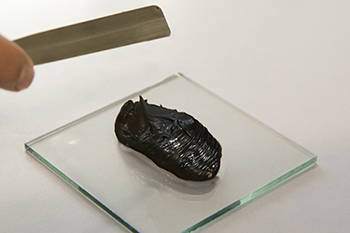
Apply mixed 2-component silicone to a PE film or glass. Use a spatula to "spread" the paste. The paste is soft at first and becomes increasingly tough as it begins to harden. When the paste resets, the end of the pot life has been reached. As the pot life is influenced by the ambient temperature and humidity, among other things, fluctuations can occur here.

Topfzeit bestimmen 1
Consistency of pasty, spreadable - Pot life not yet reached


Topfzeit bestimmen 2
Consistency of "chewing gum", the sealant "pulls back" – pot life is reached.


Glass plate test

Aim of the test:
This test serves to ensure the perfect homogeneity of the mixture.

Implementation:
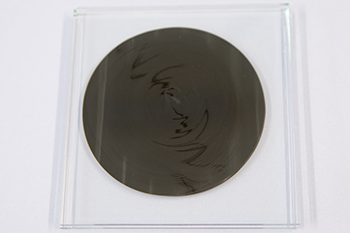
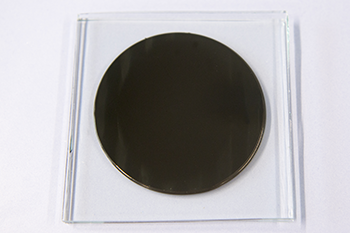
For the glass plate test, apply a small amount of the mixed adhesive to a clean glass (dimensions approx. 10 x 10 cm). Then place a second piece of glass on top and press the two glasses together. The adhesive between the glasses must be of a uniform, homogeneous colour. When processing from side-by-side cartridges, fine white streaks are tolerable.

Glasplattentest inhomogen
Inhomogeneous mixed image


Glasplattentest homogen
Homogeneous mixed image


Butterfly test

Aim of the test:
This test serves to ensure the perfect homogeneity of the mixture.

Implementation:
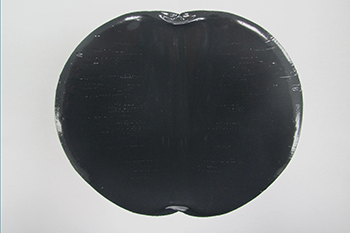
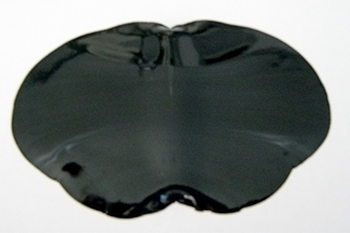
A small amount of the mixed adhesive is applied to a white sheet of paper or PE film, the paper/film is folded, pressed smooth and then unfolded. As with the glass plate test, check the mixture for streaks or smears.


Butterflytest-maschinell
Mixed image when processed via a mixing and dosing system


Butterflytest-Kartuschenverarbeitung
Mixed image for cartridge processing


Adhesion test (peel test)*

*Pursuant to ISO 21194:2019

Aim of the test:
The peel test checks the correct adhesion of the adhesive to the substrates to be bonded.

Implementation:
Apply an approx. 10 x 10 mm wide or thick adhesive strip to each of the substrates pre-treated according to the specifications in the technical data sheet of the 2-component adhesive. The length of the adhesive strip is 10 cm. After a curing time of 24 hours, cut the adhesive on one side with a knife and try to pull the adhesive off the substrate by hand at an angle of >90°. The test must be carried out for both substrates.


Haftprüfung einschneiden
Cutting between adhesive and glass pane


Haftprüfung abziehen
Pulling off the adhesive bead and assessing the fracture pattern: If there is a cohesion break in the adhesive, the adhesion to the substrate is perfect.


Step-by-step to the RC test

In addition to our products, our extensive services complete our package of services. That is why we also offer services and additional benefits in the area of bonded windows: We accompany you step by step to the RC test. Benefit from our many years of experience in the window industry: We are optimally networked with all known hardware manufacturers, window system providers and also the testing institutes.

Ascertaining your requirements

The first step to your tested RC system is precisely ascertaining your requirements. Here, it is not only a question of which RC class you want to achieve, but also which window system you are working on, which hardware you are using, which surface finish is used and how you want to apply the bonding technology.

Joint production of the test specimens

After your requirements have been clearly ascertained and the coordination with all parties involved has produced the best possible result, we put it into practice. We accompany you during the production of your test specimens and bond them with you. Here we discuss step by step what is important in RC bonding. We explain how quality control works and how OTTO adhesives are best handled.

Accompaniment up to the inspection

The next step is to go to the testing institute. Here your elements are tested and classified according to EN 1627 requirements and classification of burglar-resistant building components. First, the static strengthis tested according to EN 1628. For this purpose, precisely defined points of the test specimen are subjected to a static test load. Next, the dynamic load test is carried out in accordance with EN 1629. Finally, the manual attack on the test specimenis carried out according to EN 1630, in which the available tools and the time count: Depending on how long the test specimen withstands which tool, the burglar resistance is classified in RC classes 2, 3 or 4.

Do you have a question about “glass - window - façade"?

Our application consultation is available Monday to Thursday from 7:00 a.m. to 4:00 p.m. and Friday from 7:00 a.m. to 1:00 p.m. and will be happy to receive your request.

+49 8684 908 4300[email protected]Ask a question

Send a question to the OTTO experts

My question concerns: Reliable in the result | OTTO-CHEMIE


* Mandatory fields

OTTO-CHEMIE

  • About OTTO
  • Directions
  • Contact OTTO
  • Certification

CONSTRUCTION

  • Data sheets & test certificates
  • Application assistant
  • Product filter
  • Guidebooks, catalogues, brochures
  • OTTO construction newsletter

INDUSTRY

  • Novasil® products data sheets
  • Business development
  • Personal consultation
  • OTTO industry newsletter

Contact

Hermann Otto GmbH
Krankenhausstr. 14
D – 83413 Fridolfing
GERMANY

Quality creates cohesion

Do you have questions?

+49 8684 908 0

Central Mon. - Thur. 7:00 am - 4:00 pm and Fri. 7:00 am - 1:00 pm

Find a contact partner


TÜV Süd ISO 9001, ISO 14001


EcoVadis Goldmedaille 2026


Terms and ConditionsData Protection DeclarationLegal noticeAccessibilityCookie settings

OTTO 3D house